Kangri Language

Kangri is a dialect spoken in northern India, predominantly in the Kangra district of Himachal Pradesh, by the people of the Kangra Valley. It is an Indo-Aryan dialect, related to Dogri and classified as one of the Western Pahari dialects of the Pahari group of languages, with deep vocabulary impact from Punjabi, which is spoken to the west in the state of Punjab. Kangri, along with Dogri, has been classified as a dialect of Punjabi by linguists but since the 1960s, for political reasons, both have been promoted as dialects of a separate language group called Pahari languages.

General

  • Kangri shares vocabulary with both Hindi and Punjabi.
  • Its GRN Language Number is 780.
  • Its Ethnologue 14th edition Language Code is DOJ
  • Its Ethnologue 14th revised edition Language Code is XNR
  • Its ISO / Ethnologue 15th edition Language Code is xnr
  • The language is spoken in India (Himachal Pradesh state)

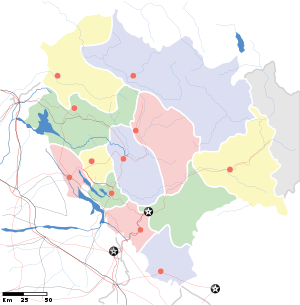
Districts of Himachal Pradesh

Himachal Pradesh locator map.svg
Bilaspur
Chamba
Hamirpur
Kangra
Kinnaur
Kullu
Lahaul and Spiti
Mandi
Shimla
Sirmaur
Solan
Una

Himachal Pradesh is divided into 12 districts namely, Kangra, Hamirpur, Mandi, Bilaspur, Una, Chamba, Lahul and Spiti, Sirmaur, Kinnaur, Kullu, Solan and Shimla. The state capital is Shimla which was formerly British India's summer capital under the name Simla.

A district of Himachal Pradesh is an administrative geographical unit, headed by a Deputy Commissioner or District Magistrate, an officer belonging to the Indian Administrative Service. The district magistrate or the deputy commissioner is assisted by a number of officers belonging to Himachal Administrative Service and other Himachal state services. Each district is subdivided into Sub-Divisions, governed by a sub-divisional magistrate, and again into Blocks. Blocks consists of panchayats (village councils) and town municipalities. A Superintendent of Police, an officer belonging to the Indian Police Service is entrusted with the responsibility of maintaining law and order and related issues of the district. He is assisted by the officers of the Himachal Police Service and other Himachal Police officials.

Shimla’s Climate

Shimla's cool climate is the precise reason why it is such a popular summer retreat. Located at an altitude of approximately 2200m above sea level, the region has a hilly terrain and is covered by dense evergreen forests. A few visitors choose to visit Shimla during spring or autumn, when the place is less crowded and the views are too spectacular for words.

Shimla Season Summary
Season Months Temperature Conditions
Spring March-April 10°C to 20°C Clear skies. Occasional rain and thunderstorms.
Summer May- June 16°C to 28°C Generally clear skies. Air might become smoky due to forest fires.
Monsoon July-September 13°C to 20°C Cool and humid. Continuous rain.
Autumn October-November 10°C to 23°C Skies are clear, chilly evenings.
Winter December-February -7°C to 10°C Generally dull weather. Frequent snowfall.

Dalhousie

Dalhousie (2036 m) is a hill station full of colonial charm that holds lingering echoes of the Raj. Spread out over the five hills (Kathlog, Potreys, Tehra, Bakrota and Balun) the town is named after the 19th century British Governer General Lord Dalhousie. It was popular with the British Army personnel in 1860's. The town’s varying altitude shades it with a variety of vegetation that includes stately grooves of pines, deodars, oaks and flowering rhododendrowns. Rich in colonial architecture, the town preserves some beautiful churches. St. John church is the oldest one built in 1863, St. Francis was built in 1894, St. Andrew in 1903 and St. Patric in 1909.

There are also magnificent views of Chamba valley and the mighty Dhauladhar range with its awe-inspiring snow covered peaks filling an entire horizon. By road Dalhousie is about 555 km from Delhi, 52 km from Chamba via Banikhet and 46 km via Khajjiar and the nearest railhead at Pathankot is 85 km away. IMG_0085
In & around Dalhousie the visitable places are:

Subash Baoli: Netaji Subhash Chandra Bose spent a large portion of 1937 contemplating here. A nice secluded place.

Panjpulla: It means five bridges. It is a picturesque spot with water flowing under the five small bridges. A samadhi of Sardar Ajit Singh, uncle of Bhagat Singh, adds to its importance. A small fresh water spring Satdhara is close by.

Bakrota hills: Visit for a brisk walk round the hills and have a view of snow clad peaks. It is 5 km from Dalhousie.

Kalatope: It is a picnic spot and a wild life sanctury, 10 km from Dalhousie and offers a fine view of the countryside.

Bara Pathar: It is 4 km from Dalhousie enroute Kalatope. In village Ahla here, there is atemple of Bhulwani Mata.

Dainkund: It is 10 km from Dalhousie. On a clear day this tall peak (2745 m) affords a birds eye-view of the hills, verdant valleys and the Beas, Ravi and Chenab rivers threading their silvery passage down to the plains.  


  • Distances from Dalhousie

       
    Places to visit
      Km
    Banikhet 7
    Bharmour 110
    Chhatrari 90
    Kalatop 10
    Khajiar 23
    Kynance 5
    Mani Mahesh 145
    Norwood Paradham 5
    Panchpula 3
    St. Andrews Church 1
    St. Francis Church 1
    St. Johns Church 2
    St. Patricks Church 2
    Subhash Baoli 1
    Jot 41

Chail Cricket Ground


Surrounded by gigantic deodar and well maintained Chail Cricket ground is the highest cricket ground in the world. Built in 1893, this cricket pitch located at the height of 2,144m is also used as polo ground.

Twitter Delicious Facebook Digg Stumbleupon Favorites More