Himachal was known since the earliest of times as "Devabhoomi", the abode of the Gods. The splendid heights of the Himalyan ranges, with its great scenic beauty and aura of spiritual calm seem the natural home of the Gods. Two thousands or more temples all over the State, reiterate this fact.
Being a State full of isolated valleys and high ranges, several different styles of temple architecture developed and there are temples with carved stone shikharas, pagoda style shrines, temples that look like Buddhist Gompas or Sikh Gurudwaras etc. Several of them are important places of pilgrimage and each year attract thousands of devotees from all over the country.
HINDU PILGRIMAGE
BAJRESHWARI TEMPLE: Just outside the town of Kangra is the temple dedicated to Bajreshwari Devi. Known once for its legendary wealth this temple was subject to successive depredations by invaders from the north. Destroyed completely in 1905 by an earthquake, it was rebuilt in 1920 and continues to be a busy place of pilgrimage.
BAIJNATH: The ancient temple at Baijnath is particularly beautiful. Built of stone in the 9th century AD, in the shikhara style, it is a fine blend of sculpture and architecture. Dedicated to Lord Shiva, Baijnath is close to Palampur and Kangra.
JWALAMUKHI TEMPLE: Not too far from Kangra is this popular place of pilgrimage. An eternally burning flame that issues from a hollow rock in the sanctum, is considered the manifestation of the goddess Devi. During March-April and September-October every year, colorful fairs are held during the Navratra celebration. Jwalamukhi temple is 30 km. from Kangra.
CHAMUNDA DEVI TEMPLE: Not far from Dharamsala (Kangra) is the famous temple to Chamunda Devi. It is an enchanting spot with glorious views of the mountains, the Baner Khud, Pathiar and Lahla forest.
LAKSHMI NARAYAN TEMPLE: The Lakshminarayan group of temples in the town of Chamba are of great archaeological importance. Six stone temples dedicated to Shiva and Vishnu with tall shikaras, finely carved, date from the 8th century AD. The Lakshminarayan Temple is the oldest in this group. Other temples around Chamba town include, those dedicated to Hari Rai, Champavati, Bansigopal, Ram Chandra, Brijeshwari, Chamunda, Narsingh, and Yogi Charpat Nath.
CHAURASI TEMPLES: The 9th century temples at Bharmaur are among the most important early Hindu temples in the Chamba Valley. According to legend, 84 (chaurasi) yogi's visited Bharmaur, capital of King Sahil Varma. They were so pleased with the king's humility and hospitality that they blessed him with ten sons and a daughter, Champavati. A cluster of shrines commemorates that visit. The temple square is the Centre of all activities in the little town of Bharmaur and the Lakshmi, Ganesh, Manimahesh and Narsing temples, the main shrines, are splendidly set off by the dramatic mountainscape.
CHATTARI TEMPLES: Not far from Bharmaur (Chamba) is the Chattari Temple with early examples of carved wood and an 8th century brass image of Shakti.
MANIMAHESH (3,950 m): The Manimahesh Lake, high up in the mountains near Bharmaur, is an important place of pilgrimage. The solitary Manimahesh Kailash Peak- the legendary abode of Shiva, is reflected in its still waters. A little temple in the shikhara style with an exquisite brass image of Lakshmi Devi as Mahishasuramardini stands near-by. Every year, following Janmashtami, the annual Manimahesh Yatra is undertaken. The pilgrimage starts from Chamba from the Lakshaminarayan Temple and devotees wend their way up the arduous track from Bharmaur to take a sacred dip in the waters of the lake.
MANDI: Mandi has a picturesque group of ancient stone temples with tall vimanas, splendidly located below the town on the banks of the foaming river. The Tarna Devi Temple (Mandi), a new shrine up on a hill, overlooks the town and valley.
REWALSAR: Around a natural lake with a floating island are a Shiva temple-the Lomesh Rishi Temple, Guru Govind Singh's gurdwara and a Buddhist monastery founded by Guru Padmasambhava. A spot that is revered by people of three faiths (Mandi).
PRASHAR TEMPLE: This temple, built in the 14th century, is a shrine where the rulers of Mandi once worshipped. The pagoda-style temple stands in the little green hollow around the Prashar lake, above the town of Pandoh. The views of the mountains are spectacular.
SHIKARI DEVI (2850 m): It is possible to trek up to Shikari Devi from Janjheli and Karsog (Mandi). Through woods of assorted trees and shrubs - which include several medicinal herbs - two separate trek routes lead up to this ancient shrine located at the crown of the hill. Hunters in the area once prayed to the Goddess for success in their hunt - and here, perhaps, lies the origin of the name 'Shikari Devi'. The Goddess is worshipped in the form of a stone image. Interestingly, the temple which is said to have been in existence since the time of the Pandavas, has no roof - for local legend has it, that all attempts to build one have been unsuccessful.
HANOGI MAA & KOYLA MAA TEMPLE: Hanogi Maa temple in on the way from Mandi to Kullu near Pandoh and Koyla Maa temple near Sunder Nagar in Mandi district.
RAGHUNATHJI TEMPLE: Built in 1651 by the Raja of Kullu, the temple has an image of Raghunathji that was brought from Ayodhya. During the Kullu Dussehra, all the temples in the area send their deities to pay homage to Raghunathji at Kullu.
BIJLI MAHADEV TEMPLE: An unusual temple dedicated to Shiva-the Lord of lightning, is located on a height overlooking the Kullu and Parvati valleys. A 60ft staff above the temple attracts divine blessing in the form of lightning and breaks the stone linga in the sanctum.
DHOONGRI TEMPLE: This four tiered pagoda, embellished in finely carved wood, stands sheltered in grove of tall deodar at Manali (Kullu). It is dedicated to Hadimba Devi, wife of the Pandava, Bhim.
BHIMAKALI TEMPLE: A marvelous example of hill architecture, the temple complex at Sarahanis set against the incredibly beautiful backdrop of high ranges and forested slopes. Built in a mixture of the Hindu and Budhists styles, it was the temple of Bushair rulers of Rampur (Shimla). The palaces of the royal family are adjacent to the temple. From Sarahan there is a view of the Srikhand Peak, revered as the home of goddess Lakshami.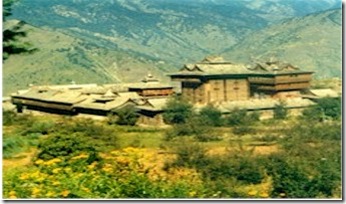
HATKOTI: Along the River Pabbar, 104 km from Shimla, is the temple dedicated to Durga and Shiva. The gods are said to have fought a pitched battled at this spot.
JAKHU AND SANKAT MOCHAN: These two temples close to Shimla have a commanding views of the hills.
NAINA DEVI TEMPLE: On a hill, close to Bilaspur and Kiratpur (34 km), is famous shrine of Naina Devi. A colourful fair, the Shravana Astami Mela is held in July-August.
CHINTPURNI: A winding road goes up to the temple dedicated to Bhagwati Chinmastika or Chinpurni-the goddess who grants all wishes. A popular place of pilgrimage, Chintpurni is about 75 km from the town of Una and 100 km from Jalandhar.
RENUKA: The temple, dedicated to the immortal Renuka, stands near the picturesque Renuka Lake (Sirmour).
TRILOKPUR: About 25 km from Nurpur (Kangra), at the confluence of the Bohar and Bhali streams, is another sacred spot popular with pilgrims of various faiths. There is a Hindu temple, a Buddhist monastery, a gurdwara and a mosque at Trilokpur.
BABA BALAK NATH TEMPLE: A cave temple located in Deothsidth, in the Dhaulagiri Hills of Hamirpur, is a noted place of pilgrimage. People come here to seek the blessing of Baba Balak Nath whose image is located in the cave. Shahtalai, 46 km from the the district headquarters of Hamirpur and accessible by road, is about 10 km from Deothsidh.
BUDDHIST PILGRIMAGES
The remote valleys of Lahaul, Spiti and Kinnaur have strong Buddhist traditions. Splendid gompas, Buddhist monasteries, built along bare mountain-sides seem to be a part of the rugged terrain. These are the repositories of a wealth of Buddhist art and culture. The dim, cool interiors of ancient monasteries glow with the brilliance of painted murals, stuccos and elaborate thangkas framed with rich borders of silk.
In Dharamsala, where the Dalai Lama has settled in exile, is a marvelous Tibetan township where an entire cultural tradition is being nurtured. It is a centre that attracts scholars, pilgrims and tourists.
REWALSAR: Perhaps the most sacred spot for Buddhists in Himachal Pradesh, Rewalsar is 20 km south west of Mandi. According to legend, Guru Padmasambhava departed for Tibet from this beautiful spot, to spread the 'dharma'. A pagoda-style monastery stands along the edge of the lake.
GURU GHANTAL MONASTERY(3020 m): This is on the right bank of Chandra river about 4 kms. above Tandi and is believed to be the oldest Gompa of Lahaul having wooden structure with pyramidal roofs, wood carving, preserving the idols of Padmasambhava & Brajeshwari Devi. On the full moon night in mid-June a festival called "GHANTAL" is celebrated by Lamas & Thakurs together.
KARDANG MONASTERY(3500 m): It is about 5 kms. from Keylong across Bhaga river. It is believed to be built in 12thcentury. Monastery has a large library of Kangyur and Tangyur volumes of Budhist scriptures in Bhoti. Kardang village was once the capital of Lahaul.
SHASHUR MONASTERY: Situated on a hill about 3 kms from Keylong (Lahaul & Spiti) towards north on the same slope. During June/ July this monastery attracts a large number of visitors when Lamas perform the devil dance. It was founded in the 17th century a.d. It belongs to red hat sec and is located among the blue pines. The paintings represent the history of 84 Buddhas.
TAYUL GOMPA(3900 m): Tayul Gompa is 6 kms. from Keylong (Lahaul & Spiti) and is one of the oldest monasteries of the valley having a huge statue of Guru Padmasamhava about 5m high and houses library of Kangyur having 101 volumes. In Tibetan language Ta-Yul means the chosen place. There is an interesting story behind this.
KYE MONASTERY: It is situated 12 kms. north of Kaza (Lahaul & Spiti) and serves the western population of Spiti. It is the oldest and biggest monastery of the valley and located at (4116 m) above Kye village. It houses beautiful scriptures and paintings of Buddha and other goddesses. Lamas practice dance, sing and play on pipes and horns. Relegious training to Lama's is imparted here. It has murals and books of high value.
THANG YUG GOMPA: It is located 13 kms. above Kaza (Lahaul & Spiti) serving western part of central Spiti. Situated in a secluded place in the narrow gauge of Kaza Nallah, it generally has a Lama from Tibet. Above this there is a long plateau which leads to Shilla peak.
KUNGRI GOMPA: It is situated in the Pin valley about 10 kms. from Attargo where Spiti river has to be crossed to enter Pin valley. It is serves the population of Pin valley.
DHANKAR MONASTERY: It is situated about 25 kms. east of Kaza and serves eastern part of central Spiti. Dhankar is a big village and erstwhile capital of Spiti King. On top of a hill there is a fort which use to be a prison in olden times. The Monastery has about 100 Lamas and is in position of Buddhist scriptures in Bhoti language. Principal figure is a Statue of "Vairochana" (Dhayan Budha) consisting of 4 complete figures seated back to back. It has relics in the shape of paintings and sculptures.
TABO MONASTERY: This is another large gompa serving the population of eastern side. It has its origin in the tenth century old and is located 50 kms. from Kaza (Lahaul & Spiti). In fame it is next to Tholing Gompa in Tibet. It has about 60 Lamas and houses a large collection of Scriptures, wall paintings etc. Murals of this gompa have similarity to that of the Ajanta paintings.
NAKO: The legendary footprints of the Guru Padamsambhava are enshrined at the Lotsabaage Monastery at Nako. This high altitude village in Kinnaur is located near a limpid lake.
TASHIGANG GOMPA: Can be visited by taking diversion from Khab to Namgya and then trekking to the Gompa.
TILASANGH MONASTERY: 1 km. trek from Ka, it is 12 km. short of Yangthang.

SIKH PILGRIMAGES
The Sikhs came to the Shivalik Hills, in Himachal Pradesh in 1695, at the invitation of the ruler of Sirmaur, to help him fight the Mughals. Guru Gobind Singh with his army, settled in Paonta Sahib in the foothills. During the reign of Maharaja Ranjit Singh, at the end of the 18th century, many of the western hill states also came under Sikh sovereignty.
PAONTA SAHIB: This is the main centre of Sikh pilgrimage in Himachal. The gurdwara picturesquely located on the banks of the River Yamuna in district Sirmour, is venerated due to its association with Guru Gobind Singh, the 10th Sikh Guru. In March, an important fair is held and the holy Granth Sahib is taken out in procession.
REWALSAR: The gurdwara at Rewalsar, near Mandi, is located on the periphery of a lake sacred to both the Hindus and Buddhists as well.
MANIKARAN: The serene location and the seemingly mysterious hot springs made Manikaran (Kullu) a place of pilgrimage in earlier times. Guru Nanak, the first Guru of the Sikhs, visited this place to spend time in meditation. A gurdwara that was built to commemorate his visit, is now a place of pilgrimage for the Sikhs.

CHRISTIAN PILGRIMAGES
Christianity made a late appearance in Himachal Pradesh, after the arrival of the British. The churches here are not more than 150 years old. Tall churches-the relics of the Raj, are to be found mainly in the small hill stations that the British created as summer retreats.
KASAULI: Still unspoiled and very much as the British left it fifty years ago, Kasauli (Solan) has a fine old church. The Christ Church, is a typically Anglican structure of the period. Its foundation stone was laid in 1844. Well proportioned, its spires, buttresses and gothic arches are framed against the stately deodars.
SHIMLA: The Christ Church, with its tall spire dominates the ridge in Shimla. This imposing structure is visible from as far away as Tara Devi, 8 km away. It was built in 1844, when Shimla was slowly coming into its own as the premier hill station of India., the Christ Church was designed to accommodate the entire Shimla congregation. Various memorials and stained glass windows fill the somber interior with colour and light.
The first Catholic edifice of Shimla, St. Michael's Church, was built in 1850, at the western end of the Lower Bazaar. Later additions have made it an unusual piece of architecture. Inside the church are five marble altars, all brought from Italy in 1855 and fine stained glass windows.
DHARAMSHALA: The stone church of St. John lies on a motorable road between Mcleodganj and Forsyteganj 8 Km from Lower Dharamshala (Kangra). It has a monument of Lord Elgin, one of the viceroys of India, who died in Dharamshala and was buried here.
DALHOUSIE: Dalhosie (Chamba) is another hill station with a number of old churches. The church near the G.P.O. looks untouched by time. It has an angular roof of inter-leafed hexagonal slates. The Catholic church of St. Francis, built in 1894, is set against a backdrop of tall pines overlooking the Subash Chowk.