Showing posts with label Tourism. Show all posts

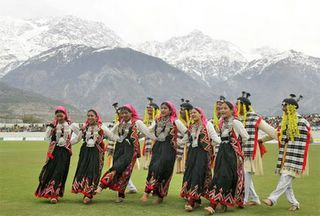
Thoda - The impressive martial art.

Thoda, the impressive martial art form of Himachal Pradesh, relies on one's archery prowess, dating back to the days of the Mahabharata, when bows and arrows were used in the epic battles, between the Pandavas and the Kauravas, residing in the picturesque valleys of Kulu and Manali. Thus, this martial art has its origin in Kulu. Thoda, the name is derived, from the round piece of wood fixed to the head of the arrow, which is used to blunt its wounding potential.

The equipment required for this game are bows and arrows. Wooden bows measuring 1.5m to 2m, to suit the height of the archer and wooden arrows in proportion to the length of the bow, are prepared by skilled and traditional artisans.

In Himachal Pradesh, in earlier days, the game of Thoda was organised in a very interesting way. A handful of village folk would go to another village, and would throw tree leaves into the village well, before sun rise. They would, then, hide in the bushes nearby, just outside the boundary of that village. As soon as the villagers came to draw water, the youths would shout, and throw challenges to them for a fight. This would spark the preparations for an encounter. wever, nowadays, Thoda is conducted in a marked court in order to have a certain amount of discipline in the game.

The competition is a mixture of martial arts, culture and sport, and is held on Baisakhi Day, April 13 and 14, and community prayers are organised to invoke the blessings of the principal deities, Goddesses Mashoo and Durga.


How the game is played

Each group consists of roughly 500 people, but most of them are just dancers, who come along to boost the morale of their team. The archers are divided into parties, just before the competition takes place. One team is called Saathi, and the other Pashi. It is believed that Pashis and Saathis, are descendants of the Pandavas and Kauravas. The target in this game is the region of the leg, below the knee, where the opponent should aim his arrow.

( Thoda held at Jaiee , Theog on 15-10-2011 )

The moment the two contesting groups reach the village fairground, both the parties dance on either side of the ground, waving their swords, aglitter in the sun, and sing and dance to the stirring martial music. The Pashi group forms a 'chakravyuh', and blocks the Saathi group, who in turn begin to penetrate their defences. After the initial resistance, the Saathis reach the centre of the ground. Both the opponents face each other at a distance of about 10 metres, and prepare to attack. The defenders start shaking, kicking their legs to and fro with brisk movements, to thwart the accurate aim of their adversaries.

Lightning movements and agility are the sole methods of defence. The whole competition is conducted to the lively, virile rhythm of war dance, with one side furiously side-stepping, legs kicking in all directions, and other side doing its best to place an arrow on the target. There are minus points for a strike on the wrong parts of the leg.

At present, the game is played in a marked court, which ensures that a certain degree of discipline is maintained in Thoda - a happy blend of culture and sport. This game is popular in Theog Division (Shimla district), Narkanda block, Chopal Division, district Sirmaur and Solan.

For Pictures Read here :
http://blog-of-himachal.blogspot.com/2011/10/thoda-impressive-martial-art-pictures.html

Handicrafts


The geographic isolation of Himachal Pradesh has allowed its people to evolve their own unique tradition of handicrafts. The extensive range includes fine woodwork, traditional embroydory, engraved metalware, beautifully patterned carpets and traditional woollen shawls.


Shawls: Extremely fine and valuable shawls, made from the wool shed by the pashmina goat are popular in Himachal. These shawls are both plain and designed. The right mix of wool can give beautiful shades of grey, blue, mustard and black. Shawl in Kullu are often woven from the wool of angora rabbits. Borders in bright geometric design are also used to add interst to plain coloured shawls.

Carpets: Carpets and blankets are an essential part of Himachali furnishing, and carpets in brilliant colours are woven with a variety of traditional motfits. There are Garudas on flowering trees, dragons, swastikas, flutes to symbolize happiness and lotus blooms to mean purity. Carpets are wooven as furnishing, as carpets saddles for horses ans as blankets or chutkas. They are part of every bride's trousseau.

Metalcraft and Jewellery: Matalcraft is one of the traditional crafts of Himachal Pradesh. The more commonely used metals are silver and copper. The local craftsmanship in casting, ornamenting and engraving of silver has evolved into classic designs. The locally available items include carved silver lamp stands, tea pots, wine cups and metal sculpture. These follow indigenous shapes and are decorated with finally carved patterns depicting flora and fauna as well as stories from legends.

Wood Craft: The most abudant wood in Himachal's forests are the pine and deodar, besides walnut, horse chestnut and wild back mulberry. Intricately carved seats, doors, windows and panels are some examples of the dexterity of Himachal's craftsment. Fruit-bowls, beer mugs, wooden jewellery and carved images are part of their modern range of products.

Stone Craft: The Shivalik hills abound in fine sandstone which is eminently suited for carvingand has played a vital role in perpetuating the stone carvers craft. Numerous stone temples still dot the Himachal landscape.

Painting: Raja Sansar Chand, who ruled Kangra in the later half of the 18th century, a patron of the arts, contributed greatly to the evolution of this genre. His palaces at Nadaun, Sujanpur Tira and various temples in the area were ornamented with murals. Jewel - like miniatures of the period, depicting court life, episodes from the life of Krishna etc., painted in rich colours are still to be seen in museums in India and abroad.

In the remote valleys of  Lahaul and Spiti are ancient gompas-Buddhist monastries which form the focus of all cultural life in the area. Some of them, nearly a thousand years old, have exquisite painted murals, stuccos and thangkas.Fine thangkas-scroll paintings on canvas, edged with a border of rich silk, are still created here.

Folk Dances

Celebrations-marriages, the harvest, festivals, local fairs, social events are all occations for a spontaneous expressions of joy-a time when the cheerful hill people take time off from their labours to sing, dance and enjoy themselves. The lilt of the ballad fills the air and skirts swing to the rhythm.

The Naati of Kullu is a favourite dance where dancer link hands and move in steps to varying rhythms. Earlier danced only by the men attired in full splendour of their traditional costumes-swirling tunics and churidars sashes and decorated caps-the naati was an affair that lasted several hours. Today the women participate too and shorter version of the 13 style of the dance are performed.

Another group dance that is popular in thje state is Karthi, a kullu harvest dance performed in the open, in the light of an autumn moon. The Burah, a martial dance from Sirmaur, is performed with the waving  of Dangras or axes to the accompaniment of the hurki. Balads recounting heroic battles and deeds are sung. The exhilarating Birsu   and Ghugti from the upper Shimla hills are performed by the Khunds as they go to the local fairs. A martial people-they hold a sword, a dangra, a khukri or a handkerchief as they dance.

The nomadic Gaddis have a fine musical tradition too. Romantic ballads narrating the story of Kunju and Chanchlo, the Romeo and Juliet of Chamba valley, are sung late into the night as the men and women dance.


Kinnaur is famous for its folk dances-Kayang, where men and women dance in semi circle around the musians and the bonyangchu, a care free dance performed by the men. The bakayang danced by the beautifull Kinnauri women, resplendent in layers of silver jewellery, presents a splendid spectacle.

Fescinating masked dance dramas are also performed in the Jubbal and Rohru valley of Shimla known as sih and bura, they narrate stories and romantic and satiriecal themes that have been handed doen orally from generation to generation.

Fairs & Festivals - January to December

Ages of rich tradition, warm and hospitable people, a landscape of breathtaking variety and beauty - all combine to pack each year in Himachal with a variety of fairs, festivals and celebrations. There are some 2000 deities worshipped in Himachal and numerous fairs and festivals are held in their honour. There are others that began as if just yesterday - and have added their colours to the grand collage. From religion to trade, from seasons to sports - and month by month - here is a joyous celebrations of life.


January
A cliche if you will - but often laced with snow - the year opens with a heady cocktail. Thousands of revellers head to celebrate the new year in Shimla, Chail, Manali and Dalhousie. Around the common calendar's new year comes Halda in Lahaul, which is a more private celebration of the event. Along the valleys of Chandra and Bhaga rivers, a few members of every household step out with lit cedar twigs to a west oriented place selected by the 'lamas'. These slender branches form the first flames of a bonfire which is then dispersed. Shiskar Apa, the goddess of wealth is worshipped, and the dancing continues for a couple of days.

There is greater sobriety, but no less joy, when Lohri or Maghi comes along in mid-January. This is the traditionary mid-winter day and also commemorates the last sowing of the Rabi crops. Community bonfires, folk songs and dancing, mark the festival. In tribal Spiti, Dechhang is celebrated at the height of winter, while the Lahaul area reserves it for early April. Paonta Sahib is a major focus on Guru Gobind Singh's birthday. The town and other gurudwaras close to it, are closely linked with the Guru's life.

On a mid-night towards the end of Paush (December-January), Phagli begins in Lahaul's Pattan valley with snow being packed in a conical basket - kilta.

This is upturned on a roof and resembles a Shivalinga. Shiva, Naga and the goddess, Hadimba are worshipped, and the younger generation also mark it by venerating the village elders. Chhang and lugari, locally brewed liquors flow freely, and ritual dishes are eaten. Kinnaur's Sazi (or Sazo), also comes at around this time.

More contemporary -events come in the form of the National Snow Statue Competition at Kufri, the Folk Dance Competition on Republic Day at Shimla. and the Water Sports Regatta at Kangra's Pong Dam. To make this wonderful time of year all the more attractive. 


February
Snow continues to play a major part in February's festivals and Himachal's Winter Carnival is also held this month.

Gochi in the Bhaga Valley is an unusual festival when the villagers celebrate the birth of male children. Token marriages of children below the age of six are also performed - and a lighter side comes with the snow balling every child participates in.

The Baba Barbhag Singh Mela is held in Una and honours this sage who was renowned for his magical powers. Basant Panchmi marks the arrival of spring in the lower areas, and every town seems to keep a reserve of colour for the occasion and the skies are filled with a medley of kites.

Ritual dances and an unbelievably rich imagery mark Lossor. This is celebrated in Buddhist areas throughout the state - while Lahaul's monasteries have some of the most spectacular performances. On its eve, the stylised chhaam dance and elaborate costumes and masks, commemorate the assassination of the cruel Tibetan king, Langdarma in the 9th century. Often - though wrongly - called 'the devil dance', it symbolises the triumph of good over evil.

March
Centered around the temple of Trilokinath, Char is celebrated in Lahaul. The town of Mandi with Its ancient temples revels in the Shivratri fair for a whole week. On elaborately decorated palanquins, hundred of local deities are carried to the town. Accompanied by folk bands, they make their first stop at the Madho Rai Temple and\then go to pay obeisance to Lord Shiva at the Bhootnath Temple. This is followed by festivities - music and song, dance and drama. Yet, all the while the atmosphere is surcharged with deep religious devotion.

In March's third week, the fascinating Nalwari fair is held at Bilaspur. Cattle is traded, there are wrestling bouts – and aero and water sports shows are recent additions.

Holi's riot of colours and celebration of spring, comes with laughter and vitality. There are exuberant celebrations at Palampur and Sujanpur. By the banks of the river Yamuna. the shrine of Paonta Sahib in Sirmour is thronged by Hindu and Sikh devotees on this day. Also in Sirmour, the Balasundari fair is held at Trilokpur near Nahan; this coincides with the sacred days of the Navratras. The temple of Baglamata, near Bankhandi in Kangra is also a major focus during these days.

Chait, the first month of lunar calendar is celebrated by the dancing of women in Kullu and by folk singing in Chamba.


At the shrine of Deothsidh (Seo) on the district border of Hamirpur and Bilaspur, a month long fair spans March and April.

April
Held on the first Baisakh -.the 13th April - Baisakhi is one of Himachal's most important festivals. Rooted in the rural agrarian tradition, it bids a flnal farewell to winter. At Tattapani near Shimla, at the Rewalsar and Prashar lakes near Mandi, people take purifying dips in the water. Numerous village fairs complete with wrestling, dancing and archery are also held on this day.

In April, Rali with its clay models is marked in Kangra. Legend has it that the beautiful Rali was married against her wishes and on the way to her husband's home, she leapt into a stream. The husband jumped in after her and trying to save both, Pali's brother also dived info the fast flowing waters. All three died. Today, clay models are made in every house to mark that day, while unmarried girls pray for grooms of their choice and the newly-wedded ask for happiness and prosperity, At Chamba, the Sui Mala is thronged by women and children and at the village of Taraur in district Mandi, the Mahu Nag fair Is held. The holy Markandaya fair Is held near Bllaspur and the Rohru Jatar is held in honour of the deity Shikhru. This is also the time when fishing and low altitude trekking raise their winter barriers, while the Spring Festival Is celebrated in Kullu from April 28 to 30.

May
May gushes In with a whole series of river rafting festivals and water sports Regattas, through-out the state. Focused around the goddess Hadimba Devi, Kullu celebrates the Dhoongri fair. In the same district, the Banjar fair and the Sarhi Jatar are held in May.

 Near Shimla at the exquisite glade of Sipur below Mashobra, the charming Sipi fair is held. It is trationally a time for match-making.

Throughout Himachal a variety of programmes are organised by the Department of Languages, Art and Culture. Dharamsala's summer festival and the programmes organised by the Tibetan Institute for Performing Arts, lift their curtains. The skies are blue and clear for the Hang Gliding Rally at Billing near Kangra, white Summer Skling glides smoothly in at the Rohtang Pass.

June
A wide spectrum of national talent, a variety of programmes and a splendid setting make Shimla's Summer Festival a memorable event. Shimla also hosts the Red Cross Fair, sport tournaments, flower shows, a photographs and posters exhibition and a fashion show based on folk costumes. The Kangra Festival is also held in June at Kangra, At Solan, on the third Sunday of the month, the Solan Fair honours the goddess Shilooni, the presiding deity of the region. On June's full moon night, the Ghantal festival is held at Lahaul's Guru Ghantal Monastery. And of course, given the time of the year and the possibilities it offers, there are various camping and trekking expeditions.

In the arid trans-Himalaya, at Kaza's Ladarcha fair, the old trade routes come alive as traders barter and sell a variety of goods and produce. At Keylong, the Lahaul Festival is also held this month.Elsewhere in the state, Haryali (Rhyali, Dakhrain) announce the advent of the monsoon rains.

July
Shravana Sankranti is celebrated at Nahan; at Arki, buffalo fights mark the Sair fair, and conducted in honour of Banar devta of Shari, the Rampur Jatar is held near Jubbal in district Shimla. July also heralds the travelling and trekking season to Kinnaur and Lahaul & Spiti.

August
Chamba's famous Minjar fair which celebrates the bounty of nature and prays for a good harvest is normally held in August. 'Minjars', maize shoots or silken strands, are cast on the waters of the river Ravi and the town immerses itself in a week of celebration.

Also in Chamba, the Manimahesh Yatra to the sacred tarn of Manimahesh is held immediately after the festival of Janamashtmi. At Bharmour, 28 km short of the lake, the nomadic Gaddis hold a fair for six days.  

Celebrated in Chamba, Kullu and elsewhere, Chrewal, Badronjo or Patroru is a festival of fire and flowers - and a time for purification of the fields.

In August, several places in Chamba, Bilaspur and Sirmour have the Gugga fair which is connected with the worship of Gugga, the Nag Devta. The same month witnesses the Dal fair in Upper Dharmsala. At Udaipur, in the Lahaul valley, the Trilokinath temple becomes a focus; this is sacred to Hindus and Buddhists alike. The Shravan fair is held at the shrine Naina Devi, while the Ashapuri fair is held in Kangra.

September
As the rains end. autumn sends fiery colours racing through the hills. In Kinnaur, the festival of flowers, 'Fullaich' (Phulech) opens a window to its remarkable people and their beautiful  countryside. Villagers scout the hillsides for flowers which are collected in the village square. These are then offered to the local deity. Then comes a spate of revelry - singing, dancing and feasting. Kalpa has some of the most vibrant celebrations and every twelve years, there is the special festival. Also in September, at the village of Chhatrari, near Chamba - and centered around the exquisite temple of Shakti Devi - a fair is held and masked dances performed.

The Kangra valley celebrates the festival of Sair. This is also celebrated with stalls, singing and buffalo fights at Arki dnd Mashobra. both near Shimla. At Nurpur in Kangra, under the watchful walls of its old fort, the Nagini fair bids the summer farewell. In the same district. on September 27, World Tourism Day is celebrated.  In Sirmour, there is a Regatta at the Renuka Lake, and Nahan hosts the Bawan Dawadashi fair.

October
There is a Regatta on the waters of the Gobindsagar, anglers vie for the largest catch in the Sangla valley and paragliders sail the skies at Billing. More traditionally, over two hundred deities converge on Kullu for its unusual Dussehra celebrations. They pay homage to Lord Raghunath while music and colour fill the 'Silver Valley'. Numerous stalls offer a variety of local wares. This is also the time when the International Folk Festival is celebrated. The Jwalamukhi Temple in Kangra becomes the venue for a major fair. At Killar and Panai (in Chamba's Pangi valley), the Phool Yatra witnesses a remarkable display of neighbourly affection and the Dehant Nag is worshipped.

November
With winter Just a hop and skip away, the age-old Lavi fair fills Rampur with a burst of activity. The town was once a major entrepot on the old trade routes to Kinnaur, Tibet, Ladakh and Afghanistan. Even today, the tradition is as vibrant as ever. By the churning waters of the river Sutlej, a variety of goods including wool, dry fruits and horses are bartered and sold.

The Kharif crops have been harvested when at the legendary Renuka lake, a fair graces its banks. There is trade, recreation and amusement. Idols of Lord Parshurama and Renuka are ceremoniously dipped in the sacred waters of the lake – and it is a time when a lot of matchmaking is done. Water Sports Competitions are held on the Pong Dam and Gobindsagar.

December 
As winter arrives, anglers shift to the Pong Dam .With the blessings of  Nobel Laureate, His Holiness the Dalai Lama, the International Himalayan Festival is held in Kangra district. Troupes from the Himalayan nations are present. The winter winds carry all the delights of ice-skating at Shimla. The extravaganza of the Ice-Skating Carnival is normally reserved for December. Christmas celebrations overtake Shimla and Dalhousie and as the church bells chime, they carry away another event-packed year, To visit the traditional fairs or to participate in the festivals, do confirm the dates as many vary from year to year.A range of accomodation is available at, or close to almost all the places.

Thoda - The impressive martial art - Pictures

( Thoda held at Jaiee, Theog on 15-10-2011 )

Click on photos to enlarge


Read About Thoda here :

Shimla - Queen of Hill Stations

Perceived and established by the British during colonial period  in first half of
19th century as their Summer Capital, Shimla acquired global fame  by   the
time  they  left  in the year 1947.  At the dawn of independence, Shimla was
known as ‘Capua of India’, the Indian Mount Olympus, the Viceroy’s
“shooting box” “Home of the heaven born”,  “abode of little tingods”. It was popularly   known  as Jewel of Orient”,  “Queen of Hill Stations”, “Star of Hill Resorts”  and “Town of Dreams”. 

Location


Shimla, the Mountain City  of India” located at 30 6`N latitude, 77 13` E
longitude and at 2100 metres above sea level, extends along a ridge and its
several flanking spurs.

Located at a commanding site in the interior Himalayas, connected   by road, rail
and  air, it  has  traditionally been a preferred destination for tourists from all over
the world.   Thousands of miles away from their mother land, amidst picturesque
Himalayan environs, Shimla can be called ‘a Wonder of Colonial Era’.
The British established many architectural masterpieces such as Vice Regal Lodge, Gorton Castle, Railway Board Building, Gaiety Theatre, Town Hall, Auckland House, Ellerglie, Barnes Court, Bungalows, Churches and  Challet Day School. Shimla also has a building called Western Side of  Gaiety Theatre North Bank where in 1907 Nobel Laureate writer Rudyard Kipling lived in 1907.  It was a dreamland of cool comfort in a very hot land, and full of promise of fun and frivolity. The 96.5 kilometre section of Kalka-Shimla railway line with 103 tunnels is an engineering feat and provides unique experience to  those  who  travel  by  this historic  route. It  is  the  most spectacular  narrow gauge railway line in the world.
The city possesses distinct British heritage including institutional buildings,
bungalows, churches, socio-cultural spaces, hotels, cemeteries, coffee houses, clubs,
theatres, schools, hospitals,  street   pattern  and street   furniture,   immensely   add
to  grace of the city with their distinct expressions. The facades of buildings,
sloping roofs, dormers, windows, doors, entrances and chimneys of numerous types
replicated from European buildings leave an ever- lasting impact on one’s mind and
provide an opportunity to understand the Western saga of art  and architecture. 

Shimla, prior to its development as a hill station was described as an “obscure
village. The village was named ‘Shimla’ after the temple of Goddess Shyamala
located in the village. In 1817, it was “a middling village”, where a fakir used to
give water to the travelers. Another legend is that ‘ Shimla’ or ‘Simla’ is named as
is pronounced by the hill people. According to Mr. W.H. Carrey the original
village of Shimla was situated on the ground lying to the east of present
secretariat buildings, above the road leading to the  Ripon hospital, and
immediately below the Roman Catholic  chapel, S. Michael’s school, and the
Court house.
Shimla, the Summer Capital of British India, is popularly known as ‘Jewel of the
Orient’. Amidst the Central Himalayas, it is a charming hill resort for tourists
from all over the globe. Ever established by the British on hill top, with unique
urban design, it is known as ‘Queen of Hill Stations’. Shimla possesses distinct
British heritage. During recent decades, after acquiring the status of state capital of
Himachal Pradesh, it emerged as a major cultural, educational and institutional
centre. Still considered as the star of India’s hill resorts, Shimla is dominated
by 19th Century colonial buildings. 


History

Shimla town has a very interesting history of its origin,  gradual growth and
development. At the beginning of last century, Shimla was taken from the Jhind
Rana in 1815 and given to the Patiala Raja for assistance rendered by him to the
British in the Nepal War. Subsequently, it was used by the Raja for a sanatorium.
It is said that the first person who brought Shimla to notice was a British officer,
who, when moving Gurkha troops from Sabathu to Kotegarh in about 1816,
passed through Shimla was impressed by its cool climate. It was a dense jungle
infested with wild beasts. It is however, claimed by Mr. A. Wilson in his ‘Abode
of Snow’ that the hill on which Shimla is situated was first made known by
Gerard brothers. These two Scotch officers were engaged in the survey of the
Sutlej valley. Their diary, dated August 30th, 1817, Shimla, a middling sized
village where a fakir is situated and gives water to travelers. They encamped on
the side of Jakhu, and had a very extensive and beautiful view.

In 1819, Lt. Ross Assistant Political Agent in the Hill States built a cottage of
wood and thatch. This was probably the first British House in Shimla. By 1824,
invalids from the plains had been given permission to establish themselves in the
locality on rent free sites provided by  the Maharaja of Patiala and Rana of
Keionthal. In 1825, a political agent,  Major Kennedy constructed a permanent
house on a rent free site. It was named as Kennedy House. In 1827, Lord
Amherst, the then Governor General of India, after completing progress through
North-West proceeded for the summer months to Shimla. This was the foundation
of Shimla’s Greatness. In 1828, Lord Combermere with his staff and the whole
establishment of Army Head Quarters came upto Shimla. During his stay, he
superintended the construction of a bridge known as ‘Combermere Bridge’ and
also a fine broad level road about three miles in length around Mt.
Jakhu. In 1829, a  house named ‘Bentick Castle’ was built for the Governor
General, Lord William Bentick. Later on, it was known as ‘Pleti’s Grand Hotel.”

The movement of British Officers to Shimla in the summers  became a  regular                
phenomenon. This was perhaps the basic contributing factor to the evolution of
“Shimla Village” into a proper town and its fame as a hill station  and
convalescent depot. Another factor that enhanced the popularity of Shimla was
its health giving attribute- ‘climate’,  which combined with every imaginable
beauty of nature-terrain, natural vegetation, springs and streams presented a very
homely atmosphere to the British. By 1831, Shimla had about sixty permanent
houses and a bazaar. Communication between these was secured by well-formed
narrow but quite safe communication routes. Following the example of British
Officers, native chief also started visiting Shimla in the summers. An
announcement regarding summer movement to Shimla reads-“should the
Governor General and Commander-in-Chief come up next season, it will consist
of British subjects-200, and native 8000 and when the tributary chieftons and
followers come in, it will be nearly 20,000. Again in winter, when but few
remain, it will probably not exceed-British subject 20, natives-2000”. Despite the
two distinctly different faces, one in summers and the other in winters, Shimla
had achieved fame as a reputed hill station within a short span of time. Shimla
during this period was accessible from Kalka by bridle path, passing through
Kasauli, Kakkarhatti, Hurreepore and Syree covering 43 miles and entering the
town at Boileauganj, one of the suburbs of Shimla. A distance of 43 miles up the
hills from Kalka had to be accomplished in a two wheel cart drawn by a couple of
ponies under the auspices of the ‘Mountain Car Company’.  Jhampan and dandy
were the other means of travel. 

Despite of the difficulties of traveling over this track, the British used to visit
Shimla every summer season like a flock of the faithful, to escape the scorching
heat of the plains and to smoothen their home sick feelings and were considered
“wise to surround themselves as far as they can with an English atmosphere”. By
1844, the number of houses in Shimla had risen to 100 as compared to 60
residences reported in 1831. Rapid growth led to necessity of providing amenities
and services. Some of the social institutions through a central authority promoted
the Municipal Committee at Shimla in 1851. The Committee was responsible for
establishment of the Town Hall with a library, Gaiety Theatre, and Police Station.
Municipal Market and Fire Brigade Services were also provided in subsequent
years. Shimla was declared the Summer Capital of Indian Govt. in 1864. In the
following years, the older, narrower track from Kalka to Shimla was improved.  A
new road named Grand Hindustan-Tibet road, 58 miles in length, passing through
Dharampur, Solan and Kiaree Ghat was built.

The emergence of Shimla as the Summer Capital also resulted in the acquisition
of several old buildings by the Govt. for its offices. In addition, construction of
new buildings was also started. A new Secretariat building, very close to the Mall
was constructed on the site of Gorton  Castle. In 1840, Peter Hoff became the
official residence of the Viceroy and remained so till 1888 when a new residence,
Vice Regal Lodge was constructed.

In 1871, the Punjab Govt. also decided to use Shimla as its summer capital. In
order to meet the water requirements of the much-increased population of the
town, the Municipal Committee installed powerful water pumps in 1901 at Churat
Nallah near Sanjauli, to lift up 200,000 gallons of water. In 1902, Walker Hospital
was opened. Prior to it there was only  one medical institution, Ripon Hospital,
built in 1885. In 1903, the electrical lighting system was introduced in the town
and the first place to benefit was the railway station. In 1904, the Kalka-Shimla
railway line was commissioned to make the town easily and comfortably
accessible. Shimla by now had grown considerably, mainly extending along the
entire length of ridge, the extreme ends of town were separated by a distance of
six miles.  Limits of the town were  bounded by the states of Patiala, Keionthal
and Koti on the Northwest, Southwest  and northeast respectively. In 1913, to
meet the increased demands of water supply, two steam pumping engines were
installed at Churat Nallah, supplying 150,000 gallons of water daily. Chaba
electricity generating station was also installed on the Sutlej, to supply electricity
to the town.

Queen of Hill Stations

Popularly known as ‘Mountain City of India’, Shimla is located at an altitude of
2100  metre above mean see level. The city extends along the east-west spinal
axis extending on either side of  the  Ridge and several flanking spurs. It was
planned and developed by the British on seven hills namely 2257 metre high
Elysium Hill, 2070 metre Summer Hill, 2449 metre Jakhu Hill, 2160  metre
Pleasant Hill, 2175 metre Prospect Hill, 2135 metre Observatory Hill and 1860
metre Annadale.  Majesty of Shimla and  its rare British heritage amidst the
serene  environs can be viewed from commanding sites  of Jakhu- the crown of
town, Kamna Devi, Tara Devi, Parimahal and Elysium Hill. The insequent,
obsequent and subsequent tributaries joining consequent streams through wooded
terrain, on one hand and deep gorges  on the other,  make Shimla more complex
and difficult to be understood and interpreted  which  add to the  mystery of  this
place. Health  giving attribute-  ‘climate, combined with every imaginable beauty
of homely, atmosphere to the British, made it a place for recoupment and
enjoyment. According to G.P. Thomas Shimla was “ A Good land, a land of
brooks of water, of fountains and deoths, that spring out of  the valleys”. It makes
an imprint on ones mind by virtue of reading about it, hearing its name and seeing
its rare setting and masterpieces of art  and architecture in it. This is the
enchantment of natures generous bounty. The air is fresh, crisp and scented by the
luxuriant forest wealth. It enters into blood and never leaves. Popularly known as
‘God of Timbers’ Deodar or Cedrus deodar forests are the pride of premier tourist
city of Shimla.

New ISBT Shimla - Photogallery

State’s first build-operate-transfer (BOT) project - an ultra-modern Inter-State Bus Terminus (ISBT), built at a cost of Rs 80 crore at Tutikandi, on Shimla bypass became operational on Aug 29, 2011

For more details Read Here :-

http://blogofhimachal.blogspot.com/2011/09/new-isbt-becomes-operational-at-shimla.html

Inter-State Bus Terminus at Tutikandi ( Shimla )

Inter-State Bus Terminus at Tutikandi ( Shimla )

Inter-State Bus Terminus at Tutikandi ( Shimla )

Inter-State Bus Terminus at Tutikandi ( Shimla )

Inter-State Bus Terminus at Tutikandi ( Shimla )

Inter-State Bus Terminus at Tutikandi ( Shimla )

Inter-State Bus Terminus at Tutikandi ( Shimla )

Inter-State Bus Terminus at Tutikandi ( Shimla )

Inter-State Bus Terminus at Tutikandi ( Shimla )

Inter-State Bus Terminus at Tutikandi ( Shimla )

List of Forts located in Himachal

Distt. Chamba

  1. Taragarh Fort, Taravas, near Nurpur, Tehsil Bhatiyat
  2. Ganeshgarh Fort, Near Shapur-16 Km., Tehsil Sihunta

Distt. Kangra

Nurpur Fort Nurpur

  1. Nurpur Fort, Nurpur
  2. Kotla Fort, Shahpur Kotla Tehsil Shahpur
  3. Haripur Fort, Haripur, Tehsil Dehra
  4. Vijaypur Fort, Tehsil JaiSinghpur, Palampur
  5. Pathiar Fort, Tehsil Kangra
  6. Mankot Fort, Tehsil Nurpur
  7. Siba Fort, Tehsil Jaswan-Kotla
  8. Jawali Fort, Tehsil Jawali
  9. Mastgarh Fort, Tehsil Nurpur
  10. Mangarh, Tehsil Dehra
  11. Ratngarh,
  12. Mao Fort (vanished) Near Kandwal Barrier, Tehsil Nurpur

Distt. Hamirpur

  1. Sujanpur Fort, Sujanpur
  2. Mahal Morian-Tal Fort, Tehsil Bhoranj

Distt. Mandi

  1. Kamlah Fort, Tehsil Dharamapur,
  2. Pangna Fort, Tehsil Pangna, Karsog
  3. Anantpur Fort

Distt. Kullu

  1. Chehni Kothi, Tehsil Banjar
  2. Manali Garh, Tehsil Manali
  3. Raghupurgarh, Near Jalori Pass, Tehsil Ani
  4. Nagar Castle, Naggar, Tehsil Kullu
  5. Mangarh, Banjar
  6. Talyara kothi, Tehsil Sainj, Banjar

Distt. Lahaul-Spiti

  1. Gondhla Fort, Tehsil Keylong
  2. Khangsar Fort, Tehsil Keylong

Distt. Kinnaur

  1. Labrang Fort, Tehsil Pooh
  2. Kamru Fort, Tehsil Sangla
  3. Murang Fort, Tehsil Pooh
  4. Sapani Fort, Tehsil Sangla

Distt. Shimla

  1. Mahasugarh, Tehsil Jubbal
  2. Samarkot, Tehsil Rohru
  3. Chaupal Fort, Chaupal town

Distt. Sirmaur

  1. Ghanduri Fortress, Tehsil Rajgarh
  2. Sirmauri Tal, Tehsil Paonta
  3. Jaitik Fort, Nahan
  4. Mangarh Fort, Tehsil Pachhad
  5. Haripur Fort, Haripur Dhar
  6. Chanderi Fortress, Chanderi, Chandpur, Tehsil Shilai

Distt. Solan

  1. Malaun Fort (Hindur), Tehsil Nalagarh
  2. Dharon ki Dhar Fort, Solan
  3. Banasar Fort, Tehsil Kasuali
  4. Nalagarh Fort (Hindur), Nalagarh
  5. Ramshahar Fort,Ramshahar town

Distt. Una

  1. Solasingi Fort, Tehsil Bangana

Distt. Bilaspur

  1. Bachhretu Fort, near Shahtalai, Tehsil Ghumarwin
  2. Baseh Fort, Jhanduta, Tehsil Ghumarwin
  3. Tiyun & Sriyun Forts near Ghumarwin
  4. Bahadurgarh, Tehsil Bilaspur
  5. Ratanpur, near Nauni, & opposite to Malaun Fort
  6. Kotkehloor Fort, Kotkehloor, Tehsil Naina Devi

New ISBT becomes operational at Shimla

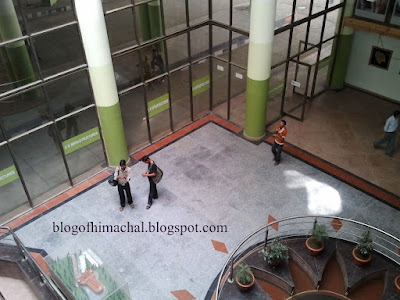
State’s first build-operate-transfer (BOT) project - an ultra-modern Inter-State Bus Terminus (ISBT), built at a cost of Rs 80 crore at Tutikandi, on Shimla bypass became operational on Aug 29, 2011

ISBT-Shimla1

Chief Minister Prem Kumar Dhumal dedicated the project to the citizens, raising hopes that similar bus stands would also be built in all major towns - six of them already cleared by the state cabinet.

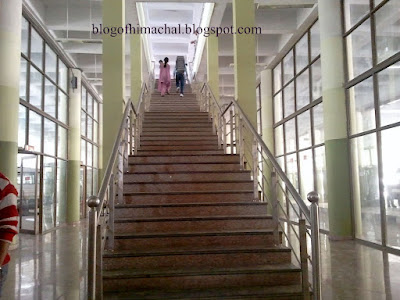
The new ISBT has 11 bays at arrival level and 24 bays at departure level with dedicated doors for entry and exit of passengers for each bay. The passenger concourse at both levels is provided with waiting area.

A police assistance booth has been set up and the ISBT is equipped with CCTV cameras for 24-hour surveillance.

There are three floors of parking to accommodate about 150 small vehicles. There is a segregation of movement of passenger, private vehicles and buses with new and dedicated drive-way for private vehicles for dropping passengers.

The integrated bus terminal also has two floors of a modern shopping mall, two multiplexes and a hotel.

Speaking on the occasion, Dhumal said the government would consider connecting the new ISBT through a ropeway with the old bus stand and railway station with scope for further extension to Jakhu to boost tourism.

“This will be done in such a way that environment and ecology of the town is not disturbed,” Dhumal said adding that additional efforts will also be made to construct more lifts and escalators in the town.

It needs to be mentioned that construction of the modern ISBT took 11 years. In the year 2000, the master plan was approved by CM Prem Kumar Dhumal and the land for the bus stand was allocated in Tutikandi.
In 2003, during the tenure of Congress government, several difficulties were faced to begin the construction work.

ISBT
It took over five years to get permission from forest department for cutting trees on the allotted site.  It was in the year 2008 that a go ahead was granted by the department.
Thereafter, the construction work began in collaboration with a Delhi-based private company, CK Infrastructure. Out of the total amount spent on its construction, Rs 16 crore was contributed by HRTC and Rs 64 crore by the private company.

Feature of modern ISBT Shimla

a. Altogether 35 bays which include 11 arrival & 24 departure bays
b. Glazed concourse and lobby
c. Modern ticketing counters
d. Furnished cloak rooms
e. Parking for nearly 200 cars
f. Hassle free traffic movement /pedestrians
g. Commercial areas (restaurant , offices )
h. Multiplexes
i. Budget hotel
j. Proposed cable trolley to mall road
k. Equipped with all modern security equipments
l. Taxi stand
m. Dormitory
n. Space for advertisements

Commercial Area plan

      Nearly 800 bus schedule will be operational from modern ISBT Shimla. These schedules include's local, inter district and inter state buses. These buses will nearly boost our commercial areas from 65000 passengers and tourists. Being capital of Himachal Pardesh we expect 15000 persons which include tourists, officials and business persons from different states and countries.

New Traffic Plan for Shimla

Consequent upon the construction of new Inter State Bus Stand, the new traffic movement from Shimla has been modified as under according to Chief Executive Officer, H.P. Bus Stands Management and Development Authority, Shimla.
The buses coming from Chandigarh, Bilaspur, Nahan side and terminating at Shimla will directly go to ISBT Tutikandi. On return journey, these buses will originate from ISBT Tutikandi.
The buses coming from upper Shimla and Kinnaur side and terminating at Shimla will continue operating via Chhota Shimla, Bemloe, old bus stand but will terminate at ISBT Tutikandi. For return journey, these buses will originate from ISBT Tutikandi and will continue operating via Lakkar Bazar, Dhalli byepass.
The buses coming from upper Shimla and Kinnaur side and going towards Chandigarh, Bilaspur, Nahan side will operate via Dhalli byepass, Sanjauli, Chhota Shimla, Khalini Chowk, Kanlog, Lalpani to ISBT Tutikandi.
The buses coming from Chandigarh, Bilaspur, Nahan side and going towards upper Shimla and Kinnaur will touch ISBT Tutikandi and after alighting and getting passengers, will continue operating via Lakkar Bazar, Dhalli to further destinations.
The old bus stand would henceforth function as local bus stand for operations within Shimla town as well as for peripheral locations within the radius of 30 kms.
All local circuit buses operating within Shimla town from various locations such as New Shimla, Sanjauli, Vikasnagar, Panthaghati, Summerhill, Shoghi etc. will continue to operate from old bus stand. However, some of them will be extended upto ISBT Tutikandi to provide better connectivity from various locations to ISBT Tutikandi.
For the convenience of vegetables and milk vendors to bring their produce to the town and daily commuters and to reduce traffic congestion, the buses operating from peripheral locations beyond Dhalli but within the radius of 30 kms. will continue operating via Chhota Shimla to old bus stand but would be extended to ISBT Tutikandi, the buses operating from different peripheral locations within the radius of 30 kms. from Tutu and Shoghi side towards Victory Tunnel, presently operating via Lakkar Bazar, Sanjauli, Chhota Shimla to old bus stand, would henceforth operate directly from Victory Tunnel to old bus stand.

The Mudrika operations on Dhalli-Chhota Shimla-old bus stand, old bus stand-Lakkar Bazar-Dhalli and New Shimla-old bus stand routes would run throughout the day except during school timings and will be extended to ISBT Tutikandi.
Besides the above arrangements, five additional shuttle buses will keep operating throughout the day from early morning to late evening between ISBT Tutikandi and old bus stand.
Some of the long route buses terminating at ISBT Tutikandi and fixed for operation in the early morning will be extended upto various locations within Shimla town to provide early morning connectivity from these locations to ISBT Tutikandi.
Connectivity between ISBT Tutikandi and six important hubs in the town, i.e. 1) Old bus stand, 2) Tutu/Summerhill, 3) Lakkar bazaar, 4) BCS/New Shimla, 5) Vikasnagar/Panthaghati and 6) Sanjauli/Dhalli will be ensured from early morning to late evening.
Special recognition stickers will be given to the buses operating from old bus stand.
Advance reservation facilities would be provided by HRTC through online reservation system and tickets can be booked by passengers even sitting at home or through Lok Mitra Kendras or through four counters run by HRTC at important locations of Shimla town i.e. ISBT Tutikandi, old Bus Stand Cart Road, Tourist Information Centre, the Mall and at Lakkar Bazar. A self serviced online reservation kiosk has also been provided at the departure level of ISBT Tuti Kandi on pilot basis and similar kiosks would be replicated at bus stands all over the State.
The general public has been requested to extend cooperation in implementing the modified traffic plan to facilitate smooth operation of public transport. However, some problems may crop up in the first few days which would be redressed in the best possible manner.

Peaks of Himachal Pradesh

Peak

No.
Peak
Height
Longitude
Latitude
Route
1 Alirathni-tibba 5470m 77° 26' 32° 05' Kulu (RH)- Malana- BC,C-I, C-II and Summit attempt.
2 Behali Jot 6245m 76° 35' 32° 50' Udaipur (RH)-Margaon-BC (Tal Got)-C-I, C-II and Summit attempt.
3 CB-10 (Tara Pahar) 6227m 77° 29' 32° 27' Manali- Chhatru-Chhota Dara-Bata (RH)- BC-C-I, C-II & summit attempt.
4 CB-11 5955m 77° 31 32° 23' -do-
5 CB-12 6258m 77° 33' 32° 20' -do-    
6 CB-13 6264m 77° 33' 32° 21' -do-
7 CB-13a 6240m 77° 33' 32° 22' -do-
8 CB-14 6078m 77° 34' 32° 22' -do-
9 CB-16 5825m 77° 32' 32° 19' -do-
10 CB-20 5695m 77° 31' 32° 24' -do-
11 CB-22 5720m 77° 33' 32° 24' Manali-Chhatru-Dhhota Dara-Batal (RH)- Linder-BC-C-I,C-II and summit attempt.
12 CB-26 5840m 77° 29' 32° 20' Batal (RH)- BC-C-I,C-II and summit attempt.
13 CB-31 6096m 77° 28' 32° 26' Manali-Chhatru-Chhota- Dara-Batal (RH)-Linder-BC,C-I,C-II, Summit attempt.
14 CB-32 5639m 77° 27' 32° 26' -do-
15 CB-33 (Minar) 6185m 77° 29' 32° 28' Matal(RH)-Dekka- BC-C-I
16 CB-34 5635m 77° 31' 32° 28' -do-
17 CB-35 5568m 77° 30' 32° 29' Manali-Batal (RH)- BC
18 CB-9 6108m 77° 27' 32° 34' Manali-Batal (RH)-BC- C-I,C-II, C-III and summit attempt.
19 Central Peak 6084 m 77° 47’ 32° 11’  
20 Deo Tibba 6001m 77° 23' 32° 11' Manali (RH)- Jagatsukh (RH)- Chhika-Seri-Tainta (BC)-C-I, C-II (Duhangan Col), C-III and Summit attempt.
21 Devachan 6200m 77° 33' 32° 14' Kulu-Manikaran (RH)- Tos Saram-Base Camp -C-I-C-II
22 Fluted 6122m      
24 Gangstang 6162m 77° 48’ 32° 42’  
23 Hanuman Tibba - I  5932m 77° 02' 32° 21' Manali-Solang-Dhundi (RH)- Beas Kund (BC)- ABC- C-I, C-II,C-III and Summit attempt.
24 Hanuman Tibba - II  5516m 77° 02' 32° 21' Manali-Solang-Dhundi (RH)- Beas Kund (BC)- ABC- C-I, C-II,C-III and Summit attempt.
25 Indra San 6223m 77° 24' 32° 12' Manali (RH)- Jagatsukh-Chhika-Seri-Tainta (BC)
26 Kangla Tarbo-I 6315m      
27 Kangla-II 6120m      
28 Kao Rong 6221m 77° 24' 32° 13' Rohtang pass-Darcha (RH)-BC-C-I, C-II and summit attempt.
29 Kharcha Parabat 6270m 77° 37' 32° 19 Manali-Batal (RH)-BC-ABC-C-I_Summit Camp and attempt to Summit.
30 KR-2 6145m 77° 20' 32° 39' Rohtang Pass-Darcha (RH)- BC - C-I - C-II and summit attempt.
31 KR-4 6340m 77° 22' 32° 39' Rohtang pass-Darcha (RH)- BC-C-I, C-II and summit attempt.
32 KR-5 6258m 77° 24' 32° 38' -do-
33 KR-7 6207m 77° 24' 32° 37' -do-
34 KR-7 6055m 77° 25' 32° 35' -do-
35 M-1 6045m 77° 20' 32° 36' Rohtang pass-Darcha (RH)- Yoch (Vill last)- BC-C-I, C-II, C-III and summit attempt.
36 M-10 5852m 77° 19' 32° 34' -do-
37 M-2 5932m 77° 23' 32° 36' -do-
38 M-3 5795m 77° 26' 32° 32' -do-
39 M-4 (Mulkila) 6517m 77° 24' 32° 32' -do-
40 M-5 6370m 77° 24' 32° 33 -do-
41 M-6 (Taragiri) 6182m 77° 23’ 32° 32’ -do-
42 M-7 6279m 77° 22' 32° 32' Rohtang pass -Darha (RH)- Yocha (last Vill)- BC- C-I, C-II, C-III and summit attempt.
43 M-8 6055m 77° 21' 32° 32' -do-
44 M-9 5680m 77° 20' 32° 32' -do-
45 Makerbeh 6069m 77° 04' 32° 25' Mandi-Palchan-Dhundi (RH)- Beas Kund (BC)-C-I, C-II,C-III and Summit attempt.
46 Manali 5640m 77° 03' 32° 24' Dhundi (RH)- Beas Kund (BC)-C-I, C-II and Summit attempt.
47 Menthosa 6443m 76° 42' 32° 55' Manali-Rohtang pass- Tandi-Udhaipur (RH)- Miyar Nallah-Urgos (Vill (last Vill,C-I, C-II and Summit attempt.
48 Ningmari 6173m      
49 Papsura 6440m 77° 33' 32° 12' Manali (RH)- Manikkaran (RH)- Tos-Saram-BC-ABC-C-I
50 Phabrang 6172m 76° 48' 32° 46' -do-
51 Shikarbeh 6200m 77° 03' 32° 26' -do-
52 Snow Cone 6225m      
53 Tent peak 5505m 77° 21' 32° 28' Keylong-Rohtang pass-Jamalang Nallah (RH)Chobia Nallah-BC, C-I, C-II, C-III and summit attempt.
54 Tige Tooth 5990m 77° 36' 32° 10' Manali- Batal Base Camp- C-I
55 Unnamed peak 5550m 77° 16' 32° 32' Domphu Gompa (RH)- Khoksar Nala-Tempala Pass (BC)- C-I Summit attempt.
56 Unnamed peak 5769m 77° 09' 32° 33' Sissu (RH)- Sissu Nallah-Malaraj Jot Pass-BC-C-I
57 Unnamed Peak 5510m 77° 17' 32° 28' Manli-Darcha- Jispa-BC
58 Unnamed Peak 5852m 77° 14' 32° 28' -do-
59 Unnamed Peak 5765m 77° 89' 32° 33' -do-
60 Unnamed Peak 5860m 77° 38' 32° 15' C-II and Summit attempt.
61 Unnamed Peak 5790m 77° 38' 32° 14' Manali- Grampho-Chhatru (RH)- Dhhota Dara-BC
62 Unnamed Peak 6360m 77° 47' 32° 08' Batal-Karcha- Barasigri Glacier-CI-CII and Summit attempt.
63 Unnamed Peak 6090m 77° 42' 32° 14' Grampho-Chhota Dara-Batal (RH)- Karcha Nala BC-C-I-C-II and Summit attempt.
64 Unnamed peak 5472m 76° 47' 32° 44' Manali-Tandi-Udaipur-Miyar Mallah-Karpat BC-C-I-C-II-Summit.
65 Unnamed peak 5598m 76° 48' 32° 46' -do-
67 Unnamed peak 5666m 76° 50' 32° 46' Urgas-Chaliry forest-Gangupa Nalah-BC-CI-C-II then Summit.
68 Unnamed Peak 6118m      
69 Unnamed Peak 5835m      
70 Unnamed peak 6484m      
71 White Sail (Dharamsura) 6420m 77° 34' 32° 12' Kulu (RH) Manikaran (RH)- Tos (Vill)- Shamshi-Sari-BC-ABC-C-I